How to Choose Commercial Cookware Before You Open Your Restaurant
Your cookware order should not start with a catalogue. It should start with your menu, cooking line and expected service volume. When comparing cookware suppliers, the goal is not to find the biggest range. It is to find the right cookware mix based on your cuisine.
Opening a restaurant in the UAE involves hundreds of decisions. The location, concept, interiors, kitchen equipment, tableware and staff usually get most of the attention. Cookware can seem like a smaller purchase, but once service begins, it is part of almost every plate leaving the kitchen. If you are planning the whole kitchen, our guide to hospitality supplies in the UAE covers the other categories.
For a busy restaurant, the wrong pan is not simply inconvenient. It can slow down service, create uneven results, add unnecessary replacement costs and make life harder for the kitchen team.
Start With Your Menu, Not a Cookware List

There is no standard cookware package that works for every restaurant.
A steakhouse, an Italian restaurant, a seafood concept and an Asian kitchen may all serve the same number of guests, but their cookware needs can be completely different.
Before choosing a single pot or pan, map your menu against the cooking methods used in the kitchen.
Ask:
- Which dishes are cooked to order?
- Which items are prepared in batches?
- How much searing, sautéing, simmering, braising or frying will take place?
- Which dishes need very high heat?
- Which dishes need gentle and controlled heat?
- How many portions of the same dish may be ordered at the same time?
- Which vessels will move from the stovetop into an oven?
A useful way to plan is:
Menu requirement | What to define |
Cooking method | Sear, sauté, simmer, fry, steam, braise or roast |
Heat source | Gas, induction, oven or specialist equipment |
Cookware | Pan, saucepan, stockpot, rondeau, wok or other vessel |
Capacity | Size required for the portion or batch |
Quantity | Number needed during peak service |
This simple exercise helps prevent two common mistakes: buying pieces the kitchen rarely uses and under-ordering the cookware used constantly.
Finalise the Cooking Line Before the Cookware Order
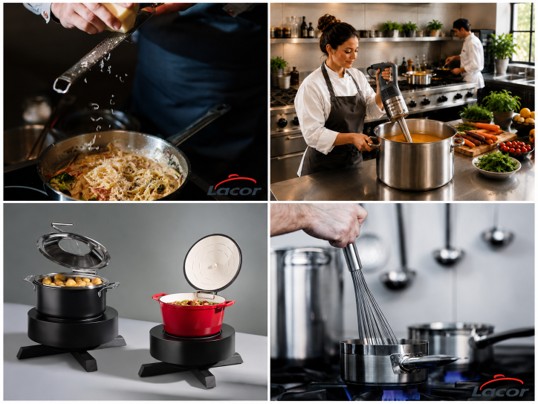
Cookware and kitchen equipment should be planned together, particularly when you’re working with a catering equipment supplier in the UAE to specify the cooking line, preparation areas and high-volume equipment.
- If the kitchen uses induction, the cookware needs a compatible base.
- If pans regularly move from the range to the oven, handles and construction must suit that use.
- If you operate a dedicated wok station, the vessel and burner need to work as a system.
The physical kitchen also matters. Think about storage, pot washing, rack space and how cookware will move between prep, cooking and cleaning. These requirements are easier to coordinate when cookware procurement is considered as part of the wider commercial kitchen equipment plan rather than treated as a standalone purchase.
This is particularly relevant when planning a restaurant in the UAE. Abu Dhabi’s food-service design guidance says the number and type of work areas depend on factors such as the operating system, business volume, menu items and the form in which food is purchased. It also treats pot and pan washing as a defined work area.
Choose Cookware by Job
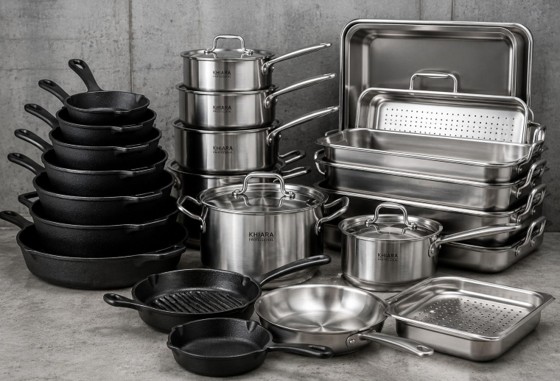
Rather than buying a large matching set, divide the requirement by cooking task. Khiara’s pots and pans come from Lacor, Chefset and Raj.
Searing, Sautéing and Pan-Frying
Fry pans, sauté pans and skillets are among the hardest-working pieces in many restaurant kitchens.
For high-volume stations, look at:
- Heat response
- Weight
- Handle comfort
- Base stability
- Resistance to warping
- Ease of cleaning
Carbon steel can work well for high-heat applications, while stainless steel is valued for durability and broad commercial use. Non-stick pans are better treated as task-specific tools for delicate foods rather than the default pan for the whole kitchen.
Sauces and Precision Cooking
Saucepans and sauciers are useful for sauces, reductions, reheating and smaller-batch preparation.
For an à la carte kitchen, a small range of smaller capacities can be more useful than several large pots.
Stocks, Soups and Batch Cooking
Stockpots and larger saucepots are important for stocks, broths, soups, pasta water and bulk preparation.
Do not automatically select the largest vessel available. Oversized pots can be harder to handle, wash and store.
Braising and Slow Cooking
Rondeaux, braziers and heavy-bottomed vessels are useful when food needs a wide cooking surface and steady heat.
They can support braising, browning, reductions and batch cooking, depending on the menu.
Specialist Cookware
Woks, paella pans, steamers, crêpe pans and other specialist pieces should only be ordered when the concept requires them.
Which Cookware Material Is Right for a Commercial Kitchen?
There is no single best material. A strong kitchen often uses several materials because they behave differently.
Material | Khiara brands | Consider before buying | Often suited to |
Stainless steel | Lacor, Chefset, Raj | Quality of base and construction affects performance | Sauces, sautéing, boiling, general use |
Aluminium | Raj, Lacor | Construction, care and application matter | High-volume general cooking |
Carbon steel | Lacor, Chefset, Raj | Needs proper seasoning and care | Searing, frying, wok-style cooking |
Cast iron | Chefset | Heavy and slower to respond | Searing, braising, selected presentation |
Non-stick | Lacor, Chefset, Raj | Coating requires careful handling and eventual replacement | Eggs, fish and delicate preparations |
Stainless steel is the most common choice in commercial kitchens, but it rarely covers every job on its own.
For restaurants comparing kitchenware wholesale suppliers in the UAE, material alone should not decide the order. Ask about thickness, base construction, handles, lids, intended heat source and the exact commercial application.
What Makes Cookware Commercial Grade?
The label ‘professional’ does not tell you enough.
Commercial cookware is used repeatedly, often at high temperatures, by several people and through long service periods. You need to evaluate how it is built.
Check the following:
- Is the base stable and resistant to warping?
- Does the cookware distribute heat well for its intended job?
- Are handles secure and comfortable during repeated use?
- Does the lid fit properly?
- Can the pan be safely used in the required oven temperature range?
- Is it compatible with your cooking equipment?
- Can multiple pieces be stacked without wasting storage space?
- Is it practical for the pot-wash team to clean?
- Are replacement lids or matching pieces available later?
Commercial cookware guides also distinguish products by material, handle design, forming method and thickness, not only by pan type. These product specifications are only part of the buying decision; restaurants should also know what makes a reliable hospitality supplier in the UAE before committing to a long-term procurement relationship.
Calculate Quantity for Peak Service
Buying the right pan is only half of the decision. You also need the right quantity.
Do not calculate cookware requirements using average daily covers alone. Think about the busiest period of service.
If six tables can order the same pan-seared fish within minutes, the kitchen needs enough pans for simultaneous orders and cleaning turnaround.
Quantity should consider:
- Peak covers
- Table turns
- Number of stations
- Menu popularity
- Number of dishes using the same cookware
- Prep requirements
- Pot-wash turnaround
- Backup pieces for critical items
This is why a bulk order should start with an operational calculation, not a discount. The same principle applies to wider restaurant procurement: buying the right quantities and standardising products can help cut restaurant supply costs without compromising quality.
For high-use items, some redundancy is sensible. For rarely used specialty items, overbuying only creates cost and storage problems.
Keep UAE Food-Safety Requirements in the Buying Decision
A restaurant’s cookware has direct contact with food, so cleanability and material suitability matter as much as cooking performance.
Dubai Municipality states that food-contact materials, including cooking utensils and pots sold in the local market, are subject to control and assessment against applicable health and safety requirements.
Requirements can differ by emirate and by operation, whether you are opening in Dubai, Abu Dhabi, Sharjah or Ajman. Check the current rules of the local authority that covers your site before you open.
Before finalising an order, make sure the cookware is suitable for food contact, practical to clean and appropriate for the way it will be used.
If your concept has special food-handling requirements, confirm them with the relevant local authority before signing off on the kitchen specification.
Open Kitchens and Tableside Service Need More Than Back-of-House Cookware
In some restaurants, cookware is never seen by a guest. In others, the kitchen is open, dishes are finished tableside or food arrives in the vessel in which it was cooked.
That changes the buying decision.
Guest-facing cookware may need to balance:
- Cooking performance
- Heat retention
- Handle safety
- Weight for service staff
- Presentation
- Consistent appearance
- Ease of resetting between services
A restaurant can use durable, practical pieces for heavy production and reserve presentation-led cookware for guest-facing moments. Where the kitchen and dining room are closely connected, plan cookware and tableware together so the pieces on the pass and on the table look like they belong.
Look at Total Cost, Not Just Unit Price
The cheapest pan is not always the cheapest option over three years.
A pan that warps quickly, loses its coating or cannot be sourced again can create repeated purchasing costs and inconsistency across stations.
When comparing wholesale cookware, consider:
- Initial purchase price
- Expected service life
- Replacement frequency
- Maintenance
- Staff handling
- Availability of the same specification later
- Spare lids or components
- Local stock and replenishment time
Spend more where cookware performance has a clear effect on consistency, speed or the finished plate. Standardise where a simpler specification does the job equally well.
A pan that warps early, or that your supplier stops stocking, costs more over time than the one that looked expensive on the quote. Ask what each piece will cost you over three years, not only on day one.
What to Ask a Cookware Supplier Before Placing an Order
A B2B cookware purchase is also a supply-chain decision.
A reliable cookware distributor should be able to support the restaurant after opening, not just deliver the first order.
Ask:
- Can we test samples before confirming a large order?
- Will the same models be available for future replacement?
- What stock is held locally?
- What are normal replenishment lead times?
- Are specifications and food-contact details available?
- Can replacement lids or components be supplied separately?
- Can you support multiple outlets if the restaurant expands?
- What after-sales or warranty support is offered?
- Can the order be consolidated with other kitchen or HoReCa requirements?
Restaurants need continuity, scale, specification control and reliable replenishment, so judge a supplier on what happens after the first order.
Where Khiara Group Fits In
Khiara Group has supplied hotels, restaurants and caterers since 1955. Its range covers more than 30,000 products, with over 15,000 ready in stock in its UAE warehouse. For commercial kitchens:
- Pots and pans: Lacor, Chefset and Raj
- Kitchen tools: Raj, Lacor and Kitchen Master
- Buffet and banqueting: Chefset
Visit the showrooms in Dubai and Abu Dhabi to compare pieces in person, or contact the team to talk through your menu and cooking line.
Final Thoughts
In a busy restaurant, commercial cookware affects the chef’s speed, the consistency of the food, the workload of the team and the long-term cost of running the kitchen.
The smartest approach is to work backwards from the operation. Start with the menu. Understand the peak service load. Match cookware to the cooking line. Choose materials for specific jobs. Then look at durability, compliance, replenishment and total cost.
For restaurants in the UAE, good cookware procurement is not about filling shelves before opening day. It is about building a kitchen that can deliver the same standard, plate after plate, when the restaurant is at its busiest.
Visit Khiara Group to learn more about our products.