Restaurant Cookware and Kitchen Gadgets: A Wholesale Buying Guide for Expanding Restaurants
The lease on your second outlet is signed, and someone asks for the kitchen equipment list. Most operators copy the list from outlet one, add a few extra pans and send it off. That list carries every mistake from your first kitchen.
This guide is for UAE restaurant operators planning a second branch, a cloud kitchen or a new menu section. You already know how a kitchen runs. The real questions are what to buy, which materials to choose and how much stock to keep. Reviewing the right commercial cookware and kitchen tools for restaurants can help you standardise essential equipment across outlets and plan future reorders.
The short answer: Buy the same core cookware and utensils for every outlet, and specify materials by grade, not price. Order restaurant cookware wholesale in case packs sized to your stock levels. Add gadgets only where they save labour on every shift.
What Should You Check in Your Current Kitchen Before Buying for a New Outlet?
Check what failed early, what sat unused and what your chefs improvised with. Your first kitchen is the best specification sheet you have for the next outlet. If you are also reviewing broader opening requirements, read our guide to essential HoReCa supplies for new restaurant owners for a wider checklist of cookware, preparation tools, storage, tableware and other supplies. Walk the line with your head chef and sort every item into three groups:
- Worked well: Reorder the exact same model.
- Wore out early: Move up a grade or change brand.
- Barely used: Leave it off the new list.
Why Should Every Outlet Use the Same Equipment?
Matching equipment helps maintain consistent portions, food presentation and operating procedures across branches. A 90 ml ladle in one kitchen and a 120 ml ladle in another can affect portion sizes and food costs. Standardising your cookware and utensils alongside your front-of-house products is also important; our guide to hospitality supplies for UAE restaurants explains how cookware, tableware and buffetware fit into a broader supply plan.
It also protects your reorders. As experts at Khiara Group put it: “A product can look perfect when you’re opening a restaurant, but if you can’t source it six months later, it can create a much bigger problem.” Before you commit to a model, ask your supplier if they hold it in local stock.
What Cookware Does a High-Volume Restaurant Kitchen Need?
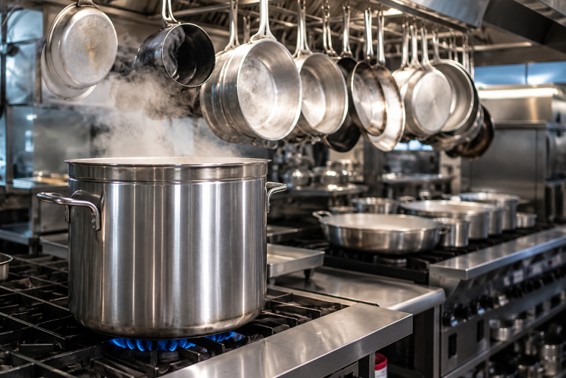
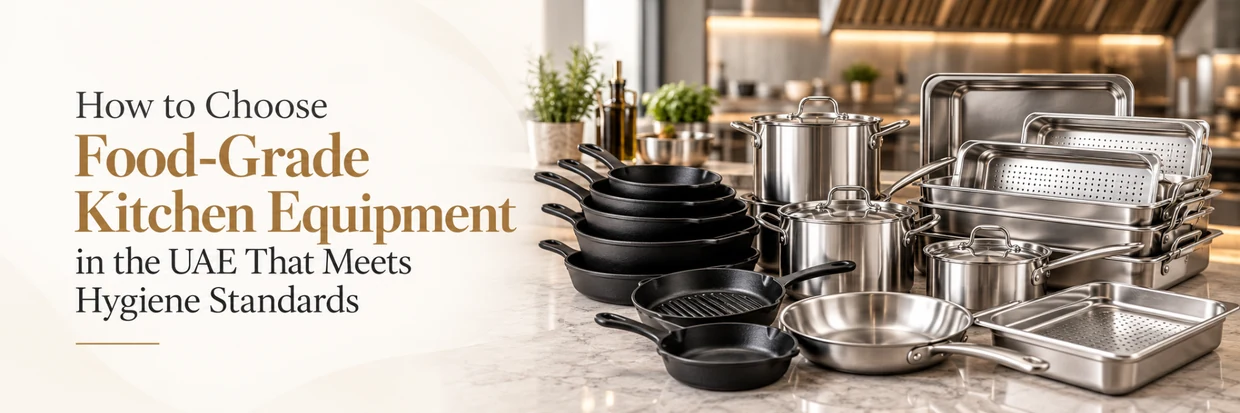
Most kitchenware for restaurant use falls into four groups: stockpots and saucepans, frying pans and woks, regional cookware, and bakeware. Volume changes what you buy within each group. Pick heavier bases, riveted handles and larger capacities than your first kitchen needed. Lacor and Chefset stockpots and casseroles are built for exactly this kind of daily heat cycle.
Opening on induction? Check every base before you order. Triply and Lacor’s induction lines work on it. Plain aluminium does not.
What Cookware do Indian, Arabic and Grill Kitchens Need?

These menus need heavy restaurant bartan: kadais, tawas, topes and tandoors. They take far more direct heat than a European sauté pan. Khiara’s Raj range covers all four, and the Corzana clay collection suits slow-cooked dishes served at the table.
Which Materials Last Longest in a Commercial Kitchen?
For most items, 18/10 stainless steel lasts longest. It is a high-nickel version of grade 304. Cheaper 202 steel looks the same on the shelf. But it carries roughly half the nickel, so it pits and stains faster (ChefPicks).
Material | Best for | Watch for |
18/10 or 304 stainless steel (8 to 10.5% nickel) | Stockpots, saucepans, GN pans, utensils | Costs more up front, but outlasts cheaper grades |
202 stainless steel (4 to 6% nickel) | Light-duty or occasional items | Pits and stains faster, especially with acidic food |
Aluminium | Large pots and sheet pans that need fast, even heat | Dubai’s Food Code says high-acid food should not be cooked or stored in it |
Triply (steel, aluminium, steel) | Sauces and induction kitchens | Heavier and pricier than single-ply |
Non-stick or granite coating | Eggs, fish and delicate items | Replace once the coating scratches or flakes |
Iron or carbon steel | Tawas, kadais, woks and high-heat searing | Needs seasoning and rusts if left wet |
Sources: Aluminium guidance from the Dubai Municipality Food Code, section 3.5.4(b).
Which Utensils Does Each Kitchen Station Need?
Buy restaurant utensils station by station, not as one long list. A station list shows gaps at a glance and makes reorders simple. Here’s the minimum each station needs.
What do You Need for Prep and Cutting?
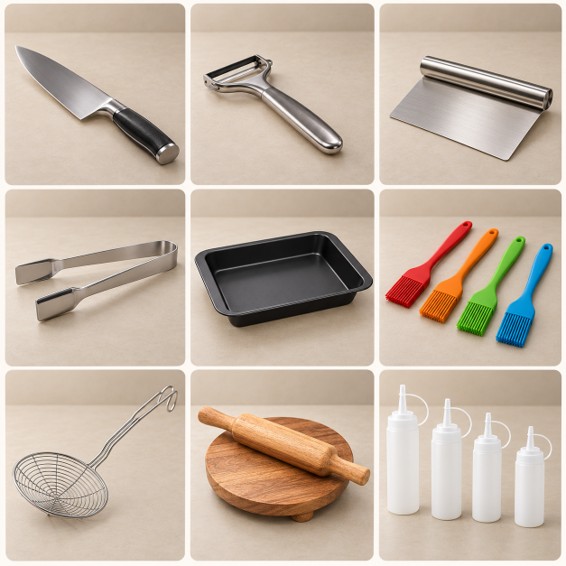
Start with a chef’s knife, boning knife, bread knife and paring knife per prep cook. Sanelli covers all four. Add peelers, a mandoline, stacking mixing bowls and cut-resistant gloves.
Then buy colour-coded cutting boards. Dubai’s Food Code, section 3.4.1(l), calls for separately marked or colour-coded boards. They keep raw meat, raw seafood, vegetables and ready-to-eat food apart (Dubai Municipality). Khiara stocks them in six colours.
Which Tools Does the Hot Line use at Every Service?
Ladles in fixed sizes, skimmers, spider strainers, tongs, spatulas and squeeze bottles. Buy two of each per cook. One gets washed while the other works.
What Baking and Pastry Tools are Worth Buying in Bulk?
Baking trays, silicone moulds, rolling pins, whisks, dough scrapers and pastry brushes. These wear slowly, so they suit a larger one-off bulk order.
What Helps at the Pass?
Plating tweezers and squeeze dispensers. They’re cheap, and they keep every plate looking the same across outlets.
How do You Store Food Safely Across Multiple Outlets?
Use a consistent GN container size system across every outlet and select materials according to the intended storage and service conditions. Standardised containers can simplify prep, storage, replenishment and transfers between branches. Explore GN pans and food storage equipment for commercial kitchens when planning a central kitchen or a multi-outlet operation. The three common materials handle different jobs:
- Polypropylene (PP): -40°C to 70°C. Good for cold storage and prep.
- Polycarbonate (PC): -40°C to 100°C. Clear, so staff see stock levels at a glance.
- Stainless steel: Ovens, steam tables and hot holding.
Add ingredient bins, dough boxes and date labels. This matters most when a central kitchen sends prepped food to several branches.
Which Restaurant Gadgets Improve Kitchen Efficiency?
The restaurant gadgets that pay back are the ones used every shift: probe thermometers, digital scales and multi-timers. Dubai’s Food Code asks kitchens to check core cooking temperatures with a calibrated thermometer and record the readings (section 3.2.8(c)). So, a probe thermometer at every hot station is a compliance tool, not an extra.
Next come mandolines, gas torches and cream whippers. For a central kitchen, add a blixer, a mincer and a planetary mixer.
Skip single-dish gadgets and restaurant accessories with parts that won’t survive a commercial dishwasher. They end up in a drawer by month two.
How do You Buy Kitchen Equipment Wholesale Without Overbuying?
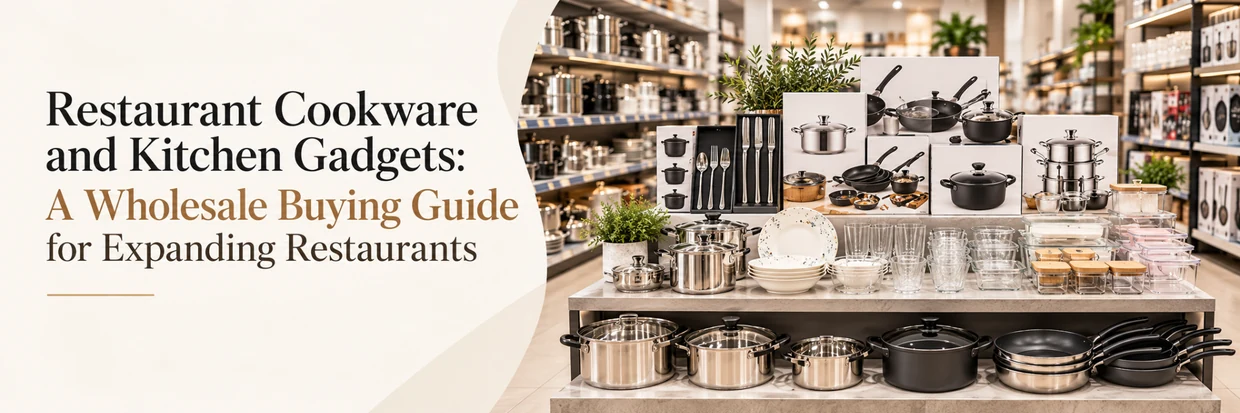
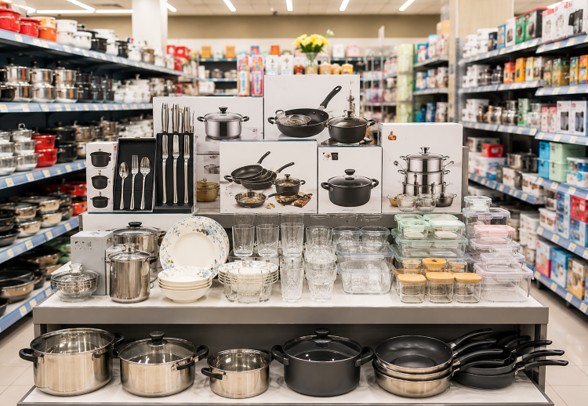
Buy restaurant cookware wholesale against your stock levels, not a guess. Count how many of each item a station uses in one service, then round up to the nearest case pack. Khiara’s catalogue lists most items in packs of 6, 12, 24 or 36 pieces.
Four habits keep the order lean:
- Price the full lifecycle cost of an item: Not just the initial purchase price, a lower-priced product may cost more over time if it wears out quickly or is difficult to replace. For more practical ways to manage procurement costs, read our guide on reducing restaurant supply costs without compromising quality.
- Track wear, then set spares: Log every replacement per outlet for three months. That log becomes your reorder schedule for non-stick pans, boards, peelers and ladles.
- Use one restaurant kitchenware supplier for every outlet: You get matching stock, one account and combined deliveries.
- Phase the order: Buy cookware, utensils and storage before opening. Add gadgets after month one, once you see where the real bottlenecks are.
Where Should You Start Sourcing for Your Next Outlet?
Start with your first kitchen’s wear record, then take it to a supplier who can match it item for item. Khiara Group has supplied UAE kitchens since 1955. It carries 30,000+ products from 170+ brands, with showrooms in Dubai and support for complete outlet fit-outs.
Our list of clients include Taj, JW Marriott, Dusit Thani, Emirates Flight Catering, and more.
Bring your list to a Khiara showrooms in Dubai or Abu Dhabi, or send it over for a wholesale quote built around case packs. Visit Khiara Group to learn more about our products and services.