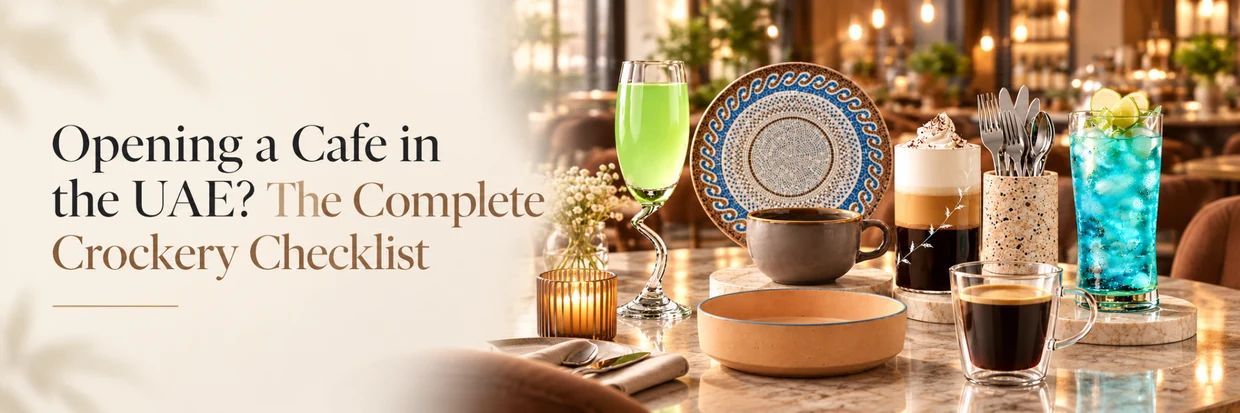
Opening a Cafe in the UAE? The Complete Crockery Checklist (With Quantities)
It’s the first Friday after your soft opening. Brunch is busy, the espresso machine is running hot, and your barista calls out: “We’re out of cappuccino cups.” The dishwasher still has eight minutes left on its cycle.
This happens in new cafes more than owners admit. Crockery feels like a small line item next to the fit-out and the coffee machine. But it’s one of the few things every guest touches, photographs and judges.
In this guide, we have provided a complete café crockery checklist with suggested quantities for a 40-seat café. If you are preparing your opening order, explore our range of commercial crockery and tableware for cafés to compare suitable options for your menu and service style.
Quick answer:
- A UAE cafe needs espresso, cappuccino and coffee cups (all with saucers), mugs for lattes, tea cups, teapots, milk jugs and sugar holders.
- For food, add side plates, dessert plates, main plates, bowls and sharing platters.
- Plan about three cups per seat in total and two to three of each plate type per seat.
- Choose commercial-grade porcelain for coffee service, and keep a reserve of about 25% for breakage and busy rushes.
What Should you Decide before Buying Cafe Crockery?
Before finalising your order, review the crockery and tableware options available for restaurant and café operations, and shortlist ranges that suit your menu, seating capacity and expected service volume.
Decide four things first: your menu, your dine-in versus takeaway split, your seating and how fast your dishwasher works. Skipping this step can leave you with too much unused stock or too few items during your first weekend rush. If you are planning a new café, our guide to essential HoReCa supplies for new restaurant owners covers the wider equipment and procurement requirements to consider before opening.
1. Your Concept and Menu
A specialty coffee bar in Alserkal Avenue needs a very different list from an all-day brunch spot in JLT. Write your menu before you write your crockery list.
- Coffee-led cafe: Mostly cups, saucers and small pastry plates
- Brunch cafe: Main plates, bowls and sharing platters matter as much as cups
- Dessert cafe: Dessert plates, cake stands and serving boards take the lead
- Serving Karak or Arabic coffee: Add small tea glasses or cups, and Finjan cups if you serve gahwa
2. Dine-in vs Takeaway
If 70% of your orders leave in paper cups, you need far less crockery. Be honest with this number. Delivery apps are a big part of the UAE cafe market, so your dine-in share may be lower than you expect.
3. Seats and Peak-Hour Turnover
Count your seats, including the terrace. Then estimate how many times each seat turns over in your busiest hour. Weekend brunch is usually the real test.
4. Your Dishwashing Setup
This is the one most owners forget. Your stock has to cover everything on tables, everything in the dishwasher and a backup on the shelf. A slower dishwasher means you need more stock.
What Crockery does a Cafe Need? The Complete Checklist

A cafe needs crockery in four groups: coffee and tea service, food service, pastry display and tabletop extras. Let’s understand these 4 groups:
Coffee and Tea Service
Before ordering in bulk, compare the available café crockery and porcelain tableware ranges to identify suitable cup sizes, matching saucers and products for your coffee and tea menu.
These pieces see the most use, so buy them first and buy them well. The sizes below come from the Ariane Vital Coupe range in Khiara’s 2026 catalogue.
Item | Example size | Why it matters |
Espresso cup + saucer | 9 cl | Small, thick walls keep the shot hot |
Cappuccino cup + saucer | 28 cl | Wide bowl helps baristas pour latte art |
Coffee cup + saucer | 20 cl | Flat whites and americanos |
Mug | 30 to 45 cl | Lattes, iced drinks and big orders |
Tea cup + saucer | 23 cl | English tea, herbal tea and karak |
Teapot | 40 cl | One to two servings per pot |
Creamer or milk jug | 15 to 35 cl | Pick a size that matches your teapot |
Sugar pot or sugar pack holder | One per table | Packs are more hygienic and faster |
Food Service
Plate sizes below are taken from ranges in Khiara’s 2026 catalogue.
- Side or bread plate (16 to 20 cm) for croissants, toast and sides
- Dessert plate (21 to 23 cm) for cakes and tarts
- Main plate (26 to 28 cm) if you serve brunch or all-day food
- Bowls for soup, salad, granola and acai
- Ramekins and butter dishes for butter, jam and sauces
Sharing platters for mezze or group orders
Pastry and Display
- Cake stands for your counter display
- Glass or acrylic domes to keep pastries fresh and covered
- Wooden boards and trays for sandwiches and sharing boards
Tabletop Extras
- Napkin holders
- Salt and pepper shakers
- Small condiment dishes
Concept-Specific Add-Ons
- Melamine for terraces, kids’ menus and poolside areas, where breakage is higher
- Stoneware plates and bowls for a rustic or earthy brunch look
- Branded hero pieces, such as a logo cappuccino cup (more on this below)
How much Crockery does a Cafe need?
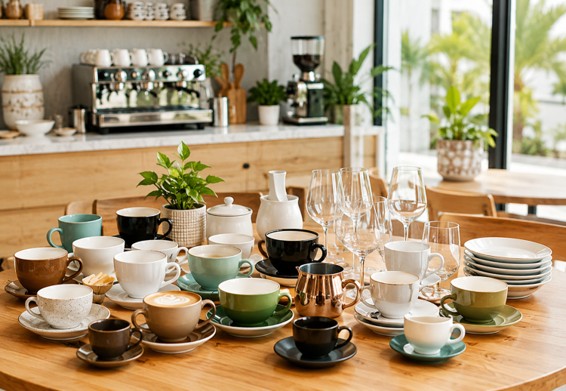
The industry standard is about three pieces per seat. That covers one piece on the table, one in the dishwasher and one on the shelf. The WebstaurantStore dinnerware guide and china maker Tuxton both suggest about 3 cups and 2 to 3 plates per seat for casual restaurants.
For cups, that means three per seat in total, not three of each size. Split that total across your cup sizes based on what guests order most.
On top of this, keep a reserve stock. US foodservice supplier Sam Tell recommends a reserve of at least 25% of the stock in active use. This covers breakage, loss and busy rushes.
Example: a 40-seat cafe serving coffee and brunch
Item | Per seat (casual dining guide) | For 40 seats |
Cups, all sizes | 3 | About 120 in total |
Cappuccino cups | Part of the 3 | About 50 |
Coffee cups (flat white, americano) | Part of the 3 | About 30 |
Espresso cups | Part of the 3 | About 20 |
Tea cups | Part of the 3 | About 20 |
Saucers | 3 | About 120 |
Mugs | Up to 3, if mugs are a main serve | Up to 120 |
Side or bread plates, 6″ (about 15 cm) | 3 | About 120 |
Dessert plates, 8″ (about 20 cm) | 2.5 | About 100 |
Main plates, 10″ to 12″ (about 26 to 30 cm) | 2.5 | About 100 |
Bowls | 0.5 to 3, depending on menu | 20 to 120 |
Reserve stock | +25% | On top of all the above |
A few notes on reading this table:
- The cup split assumes cappuccino is your top seller. Change it to match your own menu.
- Plates are listed by size in the guides, not by use. We’ve matched each size to its usual cafe use.
- Mugs are counted separately from cups in the guides. If mugs are only a small part of your menu, buy far fewer.
- Takeaway-heavy cafes can start at the lower end of every range.
Teapots, milk jugs, sugar holders and cake stands have no published per-seat standard. As a rough guide, plan one sugar holder per table plus a few spares. Then buy enough teapots and milk jugs for your busiest hour of tea orders.
These guides come from the US foodservice industry and are written for restaurants, not cafes specifically. There is no UAE-specific standard. Use them as a starting point, then adjust after your first few months of service. |
Plan for the Second Order, Too
Your first order is not your last. Track what breaks in your first three months, then set a reorder level for each item. Working with bulk crockery suppliers in the UAE who keep your range in stock makes these repeat orders faster.
“The restaurants and hotels that operate smoothly usually have a clear understanding of what they need, how much they consume and what their critical items are. Good forecasting and maintaining the right stock levels can prevent a small supply issue from becoming an operational problem.” A Khiara Group spokesperson
Porcelain, Stoneware or Melamine: Which is Best for a Cafe?
For most UAE cafes, commercial-grade porcelain is the best choice for coffee and tea service. It holds heat, handles the dishwasher every day and suits almost any interior. Stoneware works well for plates and bowls in rustic concepts. Melamine is the practical pick for terraces and family areas.
Parameters | Porcelain | Stoneware | Melamine |
Durability | High (commercial grades resist chipping) | Medium to high, heavier | Very high, almost unbreakable |
Heat retention | Good | Very good | Poor |
Look | Clean, smooth, classic or modern | Earthy, textured, handmade feel | Casual, light |
Dishwasher safe | Yes (except metallic glazes) | Usually yes | Yes |
Microwave safe | Usually yes | Usually yes | No |
Best for | Cups, saucers, plates, everything | Brunch plates and bowls | Terraces, kids’ menus, poolside |
Porcelain
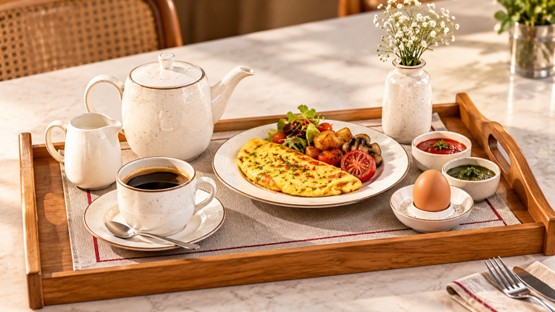
This is the workhorse of cafe crockery. Commercial ranges like Ariane list features such as high chip resistance, thermal shock resistance and dishwasher, microwave and salamander safety.
Baralee porcelain ranges, like Sand Black and Brown Splatter, give you a textured, darker look without moving to stoneware.
When you compare porcelain dinnerware suppliers in the UAE, ask which of these features each range carries.
Stoneware

Stoneware has a warm, earthy feel that suits brunch and farm-to-table menus. The Kitchen Master Forrest, Luna and Minto series cover dinner plates, side plates and bowls. Keep your cups in porcelain, though.
Stoneware is heavier, which tires baristas during a busy shift. If you’re comparing commercial stoneware suppliers in the UAE, check that each glaze is dishwasher safe.
Melamine
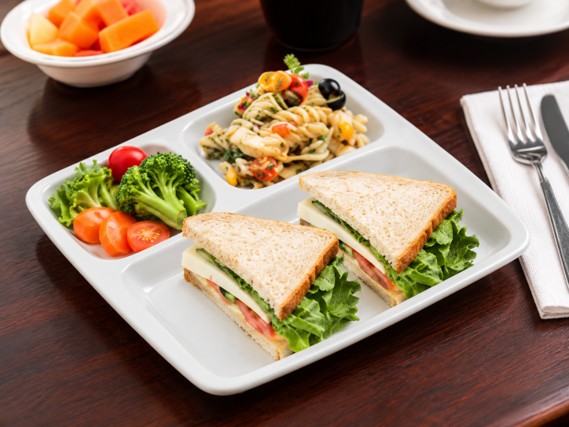
Melamine is light and very hard to break. That makes it useful outdoors, around pools and on kids’ menus. It isn’t microwave safe, so never reheat food on it. Also avoid very hot or acidic foods and drinks.
What Should you Check Before Buying Commercial Crockery?
Check eight things before you place an order: rim strength, stacking, dishwasher and heat safety, glaze consistency, weight, cup shape, food safety and saucer fit. A piece that looks great in a showroom can still fail on a busy Saturday. These checks help you spot problems before you buy 100 of them.
- Chip-resistant rims: Rims and edges take the most knocks. Look for reinforced or rolled rims.
- Stackability: Space behind a cafe counter is tight. Stackable cups and plates save shelf space and reduce breakage.
- Dishwasher and thermal shock safety: Cups go from a hot dishwasher to cold milk in minutes. Ask if the range is rated for thermal shock.
- Consistent glaze: Reactive and handmade-look glazes vary from piece to piece. That’s part of the charm, but check that the variation suits your brand.
- Weight and handle comfort: Ask a barista to hold a full cup for a minute. If the handle feels awkward, it will feel worse after 300 drinks.
- Cup shape for latte art: A wide, rounded bowl makes latte art easier to pour. A narrow, straight-sided cup makes it harder.
- Food safety: Ask your supplier for proof that the glazes are lead-free and safe for food contact.
- Saucer fit: Saucers that fit more than one cup size cut down the items you need to stock.
Why is Buying Crockery on Price Alone a Costly Mistake?
The cheapest cup on the quote is not always the least expensive option over time. Consider purchase price, lifespan, breakage and how easily you can reorder the same product. For more ways to manage purchasing costs while maintaining quality, read our guide on reducing restaurant supply costs without compromising quality.
“One of the biggest mistakes is focusing too heavily on the initial purchase price rather than the overall cost of ownership. A cheaper product isn’t necessarily cheaper if it needs to be replaced frequently, doesn’t perform well operationally, or isn’t consistently available.” A Khiara Group spokesperson
A simple Example
Here’s how it works with example figures for 100 cappuccino cups over 18 months:
Prameters | Cup A | Cup B |
Price per cup | AED 15 | AED 25 |
How long it lasts in daily use | 6 months | 18 months |
Times you buy it in 18 months | 3 | 1 |
Total cost for 100 cups | AED 4,500 | AED 2,500 |
Cup A looks cheaper on paper. Over 18 months, it costs AED 2,000 more. And that’s before the extra delivery and staff time, or the day you run out mid-service.
Think About Month Six, Not Just Opening Day
This is the part most first-time buyers miss. You will need to reorder. If your chosen range is discontinued or out of stock, your tables end up with mismatched cups.
“The initial order is only one part of the equation. What matters just as much is what happens afterwards: availability, consistency and the ability to reorder the exact same product when you need it. A product can look perfect when you’re opening a restaurant, but if you can’t source it six months later, it can create a much bigger problem.” A Khiara Group spokesperson
Before you commit, ask whether the range is a continuing line and whether it’s stocked in the UAE.
Can your Crockery Help Build your Cafe Brand?
Yes. In the UAE, many guests photograph their flat white before they drink it. Your cup, plate and saucer often end up on Instagram. That makes crockery one of your cheapest and most visible branding tools.
“There is a growing shift towards customisation and brand consistency across every guest touchpoint. Restaurants are realising that tableware, glassware, cutlery and serving pieces aren’t just operational items anymore. They are part of the brand experience. Our blog on choosing the right crockery for your cafes explains this in detail” A Khiara Group spokesperson
UAE café guests expect more than good coffee. The presentation of cups, plates, glassware and serving pieces also contributes to the overall experience. For more ideas on choosing tableware to suit your concept, read our guide to restaurant tableware and buffetware in the UAE.
How to Brand your Crockery Without Overspending
- Keep the base range neutral: White or soft-toned porcelain is easy to reorder and matches anything.
- Brand your hero pieces: Put your logo on the cappuccino cup or dessert plate, the items guests photograph most.
- Think about logo placement: A logo on the cup’s side or on the saucer shows up best in photos.
- Plan for lead times: Custom printing takes longer than stock items, so order before your fit-out ends.
What Should You Ask Your Crockery Supplier Before the Opening Order?
Ask about local stock, reorder lead times, samples, product-range continuity, bulk pricing and customisation. These details help you assess whether a supplier can support your café beyond opening day. You can also read our guide on choosing a reliable hospitality supplier in the UAE for more points to consider before committing.
“The expectation has moved from simply being a supplier to being a solution partner. Clients want faster responses, better product knowledge, customisation, competitive pricing and, most importantly, reliability.” A Khiara Group spokesperson
Use these questions before you sign off on your order:
- Is this range stocked in the UAE, or is it shipped in for each order?
- How long does a reorder take?
- Can I see and hold samples, or visit a showroom?
- Is this a continuing line? Has it been discontinued before?
- Do you give bulk quotes for opening orders and multiple outlets?
- How long does custom logo printing take?
- What support do I get after delivery?
Local stock matters more than most owners expect. A supplier with UAE stock can replace broken pieces much faster than one that ships each order from abroad.
Your Next Step
Don’t order crockery from a PDF or a product photo. Pick your top three cup ranges, then hold them, stack them and pour into them with your barista. Ask the supplier how fast they can restock each one.
The best way to choose tableware and kitchen equipment is in person. Visit our stores in Dubai or Abu Dhabi, and our team will help you build a list around your menu and budget.
- Abu Dhabi: Building 520, Old Airport Road, Al Manhal
- Dubai: Speedex Centre, Salah Al Din Street, Deira
Can’t visit? Explore khiaragroup.com or browse our 2026 catalogue of 30,000+ products from 170+ brands. We deliver across all seven emirates.
Since 1955, we have supplied Emirates Palace, JW Marriott, Hyatt, Taj Hotels, Anantara, Address and Emirates Flight Catering.
Visit a store this week, or WhatsApp us on +971 55 957 4518 for a quote.